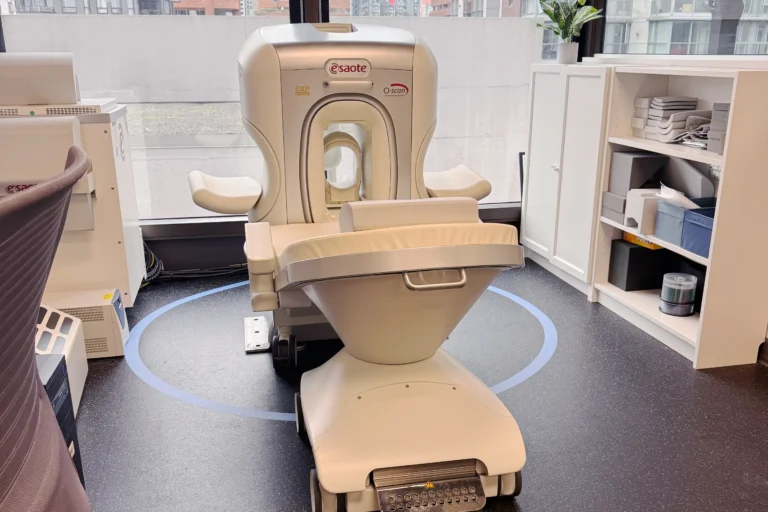

1) Client comfort: more space, less intimidation
Low-field and extremity-focused MRI setups are often built for approachability—helpful if you’re anxious about scanning. Research comparing newer low-field systems has found clients report them as more comfortable (including factors like space and noise).
2) Less artifact around metal (in many scenarios)
In some cases, lower field strength can reduce certain MRI artifacts—particularly susceptibility effects—meaning cleaner images around metal hardware can be possible depending on the situation and protocol.
3) Potentially lower RF energy deposition (SAR)
A technical (but real) point: SAR relates to RF energy absorbed by the body and tends to increase with higher field strength. Lower field can be advantageous from a SAR standpoint, depending on the exam.
4) A great match for extremity imaging
Extremity imaging (knees, ankles, feet, elbows, wrists, hands) is one of the areas where low-field MRI has been seeing renewed attention and ongoing improvement in musculoskeletal applications.
Where InForm fits in
At InForm Imaging, we focus on low-field extremity MRI—anything from knees to toes and elbows to fingers. Our scanner is purpose-built for musculoskeletal imaging, and we work closely with specialized radiologists to tailor our protocols and sequences specifically for extremity anatomy. A key clarification for website visitors:
We do not provide diagnostic imaging, which is why clients can book independently without a referral. Our imaging is not intended for surgical planning. If you have symptoms or need diagnosis or treatment decisions, please consult a licensed healthcare provider and obtain appropriate diagnostic imaging through the clinical system.